Read online Eccentric Forms of Hebrew Verse (Classic Reprint) - Israel Davidson file in ePub
Related searches:
2 timothy form and power 2 timothy 3:5in this, his last letter and legacy, the apostle paul is much occupied with the anticipation of coming evils. It is most natural that the faithful watchman, knowing that the hour of relieving guard was very near at hand, should eagerly scan the horizon in quest of the enemies that might approach when he was no longer there to deal with them.
These are solemn poems, composed of a mixture of free verse and traditional poetic meters and forms, which create the impression of an old poetry. When thinking of poetic influences, instead of modern poetry, we might think of sappho, catullus and petrarch.
The hebrews observe that all the letters in the name of god are literae quiescentes, letters of rest. God only is the centre where the soul may find rest: god only can speak peace to the conscience.
The man brute precisely translates the hebrew words; one whom god has endowed with manhood, but who has debased himself to brutehood; a man as being of god's creation in his own image, but a brute as being self moulded (shall we say self made?) into the image of the baser animals! --henry cowles.
Hebrew transliterated 1:2 vh'aurtsh hythh thhv vbhv vchshk 'yl-phny thhvm vurvch 'alhym murchphth 'yl-phny hmym. Latin vulgate 1:2 terra autem erat inanis et vacua et tenebrae super faciem abyssi et spiritus dei ferebatur super aquas. King james version 1:2 and the earth was without form, and void; and darkness was upon the face of the deep.
The employment of unusual forms of language cannot be considered as a sign of ancient hebrew poetry.
Relevant hebrew old testament words� the old testament speaks much of god having an almost unbelievable love for people. The main hebrew words used in the old testament to define god’s love are “ahab”, “ahabah”, “habab”, “hashaq” and “hesed”.
Biblical hebrew poetry has several distinctive formal features and notable genres that shape but do not limit the poetic imagination.
Silluq: marking the last tone-syllable of a verse (placed just ahead of the soph pasuq). ‘oleh weyored: marking the principal division of the verse—the logical mid-point. ’athnach: marking the principal division of the second half of a verse when following ‘oleh weyored.
10 he also says, “in the beginning, lord, you laid the foundations of the earth, and the heavens are the work of your hands. 11 they will perish, but you remain; they will all wear out like a garment. 12 you will roll them up like a robe; like a garment they will be changed.
Most hebrew words are generally accented on the last syllable of the word: however, some words (segolate nouns, furtive patach nouns, certain verb forms) accent the next to last syllable. In the vocabulary sections of the units, i will indicate non-standard accents by using the symbol above the accented syllable:.
He regularly shatters hebrew words into little syllabic cups of meaning. Arabic, polish, and especially yiddish words are scattered everywhere in his verse. In his later works he even devises his own system of vowelization. He was, in sum, a great experimentalist—an eccentric giant of hebrew modernism.
Now, a controversial new theory has proposed that the original alphabet was actually an early form of hebrew. If it turns out that the world’s oldest alphabet was hebrew, and that moses did, in fact, use it to write the torah, that would change how the world views the exodus period� the bible, and world history.
It is theorized that the history of the hebrew text goes as follows: 1) scripto continua, 2) the separation of words and the introduction of vowel-letters, and 3) verse division. Jewish rabbi philosopher, isaac nathan ben kalonymus, adopted langton’s chapter divisions of the old testament and numbered the verses according to the verse.
Hebrews clearly lays out the present priestly ministry of christ in the life of the believer. Jesus is both the divine son of god and completely human, and in his priestly role he clears the way for human beings to approach the father in heaven through prayer (hebrews 4:14–16).
Hebrews 11 – the faith in action of the patriarchs galatians 5:6 – we need to have “faith working through love”. Matthew 6:30-33 – of little faith, seek first, and all these will be added.
Hebrew verbs, unlike english verbs, are inflected for causation. You can look at a verb form and tell if the subject of a sentence is causing something to happen to something else.
The patterns which distinguish hebrew poetry are found at several levels: sound, meter, word, and imagery.
—in post-biblical literature: in the oldest post-biblical hebrew poetic productions extant, that is, the liturgy, the principle of parallelism is existent, though not exhibiting the regularity and symmetry of the biblical poetry.
Unlike some modern poetry that rhymes, the main poetic forms of the psalms, indeed of hebrew poetry, are elegantly crafted lines that structure how one thought or idea is related to another.
Several goals are accomplished by verse 1 for the author of hebrews. First, he quotes from genesis 14:17-20 so that it is clear that he is drawing from the historical material found in genesis. This is a shift from his earlier references to melchizedek as mentioned in psalm 110:4.
The church christ who, although he existed in the form of god, did not regard equality with god a thing to be grasped, hebrews 11:1.
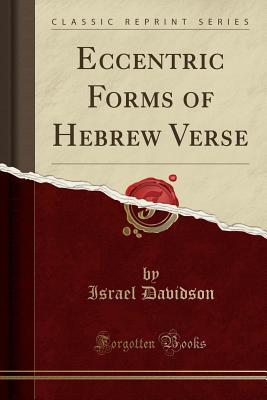
Eccentric forms of hebrew verse by davidson, israel, 1870-1939.
Answer: a major literary device in hebrew poetry is parallelism. Often, the parallelism is synonymous—the same idea is restated in different words, side by side (see psalm 40:13). Antithetical parallelism provides an antithesis, or contrast. A verse containing antithetical parallelism will bring together opposing ideas in marked contrast.
Verse 2 but his delight is in the law of the lord, and on his law he meditates day and night. (rsv) delight: the hebrew word chephets (strong's #2656) is a desire to acquire something that is valuable and may be a desire for an object, such as gold or silver, an action that one seeks, such as salvation, or, as in the context of this verse, a concept, such as the law of the lord.
Being such as do so; οἵτινες) serve a copy and shadow of the heavenly things (ὑπόδειγμα here, as in hebrews 9:23, means representation, in the way of copy, not of pattern.
The hebrew word translated with a high hand in this verse in numbers 15 is ruwm and means to be lofty, exalted, set on high - deciding for themselves what is truth. The tenth letter of the alephbet is the yod and literally means 'of the hand' or lifting of the hand', as in 10 fingers.
Summary of verse 4: one of the shepherd's most important tools was his staff. He used it to guide a member of the flock as well as use it as a weapon to defend the flock. In the ancient hebrew mind, the staff was also a symbol of authoritiy.
Biblical poetry is predominately written in this verse form of parallelism. Types of parallelism in hebrew poetry parallelism describes the recurrent use of a relatively short sentence-form that consists of two (couplets) or more (triplets) brief clauses or phrases.
The other occurrence is on day 6 (verse 1:24), when god said, let the earth bring forth living creatures. Then we see in verse 25 and god made (or had made) the beasts of the earth.
The story of how the manuscript of boris pasternak’s doctor zhivago was smuggled out of the soviet union is drab compared to the odyssey of a recently published collection of strange, curious, and perhaps very important verse by chaim lensky 1 —a soviet hebrew poet who vanished in a siberian labor camp in 1942.
Tombstone epitaphs take on many forms and are derived from many sources. One of the most popular forms are taken from biblical scripture. Bereaved family members often choose a biblical verse as an epitaph as it may exhibit some virtuous quality that was a characteristic of the decedent's life.
Try this amazing book of hebrews quiz which has been attempted 4784 times by avid quiz takers.
Apostates are those who move toward christ, right up to the edge of saving belief, who hear and understand the gospel, and are on the verge of saving faith, but then reject what they have learned and turn away.
In other words, this was not some later, pagan corruption of the savior’s name; rather, it was the natural greek way of rendering the hebrew/aramaic name yeshua at least two centuries before his birth, and it is the form of the name found in more than 5,000 greek manuscripts of the new testament.
These days atheism seems to be the most popular choice of belief of people. “can’t argue with science!” it is true that science provides a great many things, a framework of classifying phenomena as observable evidence presents itself. Though this being said, science for all its contributions is not the end all, it cannot.
“without form, and void” king james version (kjv) translation, meaning, context. The precise meaning of this wording is unclear since the original hebrew phrase tohu wa-bohu (תֹ֙הוּ֙ וָבֹ֔הוּ) is ambiguous.
Yeshua in hebrew is a verbal derivative from to rescue, to deliver. Among the jews of the second temple period, the biblical aramaic/hebrew name יֵשׁוּעַ yeshua‘ was common: the hebrew bible mentions several individuals with this name – while also using their full name joshua.
1–6� concentric arrangement of structure within the psalms and even discovers similar structures between psalms.
Hebrew is written from right to left, so the first letter on the right is the intial letter in each verse. (for correct display of the hebrew text on this page you may need to download and install the sbl hebrew font). In the english translation, we put in red the english word that represents the initial hebrew word in each verse.
Oct 20, 1985 a specialized study of the art of biblical poetry is in some ways a tougher proposition.
The study of manneristic forms in hebrew poetry has scarcely progressed since the beginning of the century. A first important step was made by israel davidson in an english article eccentric forms of hebrew verse (1914), also published in an enlarged hebrew version (1918).
The prophets are among the oddest and most eccentric characters of the old testament. Put bluntly, the behavior of old testament prophets was so bizarre that by today’s secular standards of sanity they would end up institutionalized, or, at the very least, in some form of intensive therapy.
A full-scale study of chiasmus in ancient hebrew poetry1 would require more time and there follow paragraphs on chiastic forms of the monocolon, tricolon, tetracolo jacob's rivalry with esau) that this poem is a unit, concentr.
What does hebrews 10:22 mean? [⇑ see verse text ⇑] this passage is a point of encouragement, following a long explanation. The writer of hebrews has completed his description of how the new covenant is superior to the old covenant. This was supported using many old testament scriptures, as well as other convincing arguments.
Hebrews 4:14-16 are the link connecting all the preceding part of the epistle with the next great section,� heb 5:1 to heb 10:18. Following the example of luther, tyndale and coverdale begin the fifth chapter here; but the connection of the three verses with what precedes is too close to justify this.
Hebrews 9:1 view whole chapter see verse in context then verily the first covenant had also ordinances of divine service, and a worldly sanctuary. Hebrews 9:10 view whole chapter see verse in context which stood only in meats and drinks, and divers washings, and carnal ordinances, imposed on them until the time of reformation.
The hebrew and yiddish languages use a different alphabet than english. The picture below illustrates the hebrew alphabet, in hebrew alphabetical order. Note that hebrew is written from right to left, rather than left to right as in english, so alef is the first letter of the hebrew alphabet and tav is the last.
Piece of verse having fourteen lines; a sonnet quatrain: stanza of four lines of verse quatrayle: great-great-great grandfather quatrefoil: four-petalled flower; design or ornament with four flowers or leaves quatridual: lasting for four days quatsch: nonsense quattrocentism: style of art of the fifteenth century in italy quattrocento.
Silluq: marking the last tone-syllable of a verse (placed just ahead of the soph pasuq). ’athnach: marking the principal division of the verse—the logical mid-point. Segolta (like an inverted segol above and following the word) and shalsheleth (with shalsheleth gadol above the final syllable and the vertical stroke legarmeh.
Polybius (26 10) tells us that his eccentric ideas caused some to speak of him as a man of pure motive and humble character, while others hinted at insanity. The epithet epiphanes is an abbreviation of theos epiphanes, which is the designation given himself by antiochus on his coins, and means the god who appears or reveals himself.
To view this online interlinear you need acrobat reader for easier sublinear reading the format has been changed left-to-right.
לכן חכו לי נאם יהוה ליום קומי לעד, כי משפטי לאסף גוים לקבצי ממלכות, לשפך עליהם זעמי כל חרון אפי, כי באש קנאתי תאכל כל הארץ (zephaniah 3:8 – the only verse in the hebrew bible that contains all medial forms of the letters plus all final forms).
For the word that god speaks is alive and full of power [making it active, operative, energizing, and effective]; it is sharper than any two-edged sword, penetrating to the dividing line of the breath of life (soul) and [the immortal] spirit, and of joints and marrow [of the deepest parts of our nature], exposing and sifting and analyzing and judging the very thoughts and purposes of the heart.
The effect of these shifts and revisions is reinforced by whitehill's language, slightly eccentric as compared with standard israeli hebrew and lacking any firm hierarchy among linguistic strata drawn from jewish liturgy, the israeli media, the bible, classical hebrew literature, the classroom, and the marketplace.
It it subsumes not only parallelismus membrorum but also other forms of poetic key key words: biblical hebrew poetry, literary theory, psalms, recurrence, the second dimension in mark's formulation only takes concentric struct.
Who being the brightness of his glory or of glory; of god the father, the god of glory, and who is glory itself; so called on account of his glorious nature and perfections and because of the glorious manifestations of them in his works of creation and providence, and in the various dispensations of his grace, and especially in his son; and because he is the author of all glory.
Post Your Comments: