Read Education and Art in Soviet Russia, in the Light of Official Decrees and Documents - Max Eastman | ePub
Related searches:
Art and Art Education in the USSR SpringerLink
Education and Art in Soviet Russia, in the Light of Official Decrees and Documents
Education and art in Soviet Russia : in the light of official
The National Council of American-Soviet Friendship and Art in the
Education, literacy, and the Russian Revolution International
Mastering the Art of Soviet Cooking: A Memoir of Food and Longing
35 Communist Propaganda Posters Illustrate The Art And
Women at the Gates Gender and Industry in Stalin’s Russia
How churches in the Soviet Union were desecrated and
Art Education in the USSR Article about Art Education in the USSR
Aesthetic Education in the Soviet Union - JSTOR
The Artistic Explosion in Turn-of-the-Century Soviet Russia
University of Houston Digital Library: Socialist and
Education in the Soviet Union - Wikipedia
Russian Art: Facts and Key Movements - ThoughtCo
Education in the Soviet Union – Stalin Society
History of Art in the Soviet Union: Propaganda, Rebellion
The story of art in the Russian Revolution Blog Royal
Not Just Propaganda: A New View of Soviet Artists - The New York
Stalin - Role of Education, Arts, Media and Propaganda
At the Museum of Russian Art: ‘The Body in Soviet Art
(PDF) History Teaching in the Soviet School of the 1920s-1930s
The story of art in the Russian Revolution Blog Royal Academy of
Lenin on the Most Important of the Arts – Seventeen Moments
Russia - The visual arts Britannica
Life in the USSR Boundless World History
How graphic design shaped the Russian Revolution Wallpaper*
Education corruption, reform, and growth: Case of Post-Soviet Russia
The Management of Art in the Soviet Union1 - RACO
The art of the Russian avant-garde – Smarthistory
Revoliutsiia! Demonstratsiia! Soviet Art Put to the Test The Art
Faiza part proofreading (1).docx - Conclusion The Soviet art
Russia - The Brezhnev Era
Life in the USSR Under Stalin: Nationalities & Culture
The Personality Cult of Stalin in Soviet Posters, 1929–1953
Womenand the 's Rights cold WaR - Harvard University
The Quickest History of 20th Century Art in Russia - YouTube
Born in Soviet Exile, They Might Die in a Russian One - The
The Moscow Times
Russian Constructivism and Graphic Design CreativePro Network
The Arts in Russia Under Stalin by Isaiah Berlin The New
English-taught courses and programmes - Study In Russia
Marxism and Education
The birth of soviet art was preceded throughout the 1920s by an era of intense ideological competition between different artistic groupings each striving to ensure their own views would have priority in determining the forms and directions in which soviet art was to develop, seeking to occupy key posts in cultural institutions and to win the favour and support of the authorities.
Tracing the art education behind and production of klutsis’s work shows the important hand of the soviet union in transforming definitions of art and society. It was through this hand that the soviet regime facilitated the use of propaganda to create a new understanding of russianness.
The theory of socialist realism was adopted by the congress of soviet writers in 1934. Approved by joseph stalin, nickolai bukharin, maxim gorky and andrey zhdanov, socialist realism demanded that all art must depict some aspect of man's struggle toward socialist progress for a better life.
Russian socialist federal soviet republic (later the union of soviet socialist republics). The russian revolution went though several stages, and in october 1917 an insurrection brought to power the bolshevik party (communists) committed to a radically new form of society. “in order to put an end to the survivals of feudalism, the estates.
Constructivism was a groundbreaking movement in art, design, and architecture that began in russia in 1913, but really rose to prominence after the russian revolution of 1917. This revolution was a time of great dissent and change, leading to the dismantling of the tsarist regime in favor of the bolsheviks.
Education was a key factor, as is well explained by a petty-bourgeois english writer on education who studied the soviet education system: “the task of building from the ruins of the russian empire a modern, industrial, and socialist society has pushed on with a ruthlessness – and at a human cost – that is well known.
1796: russia’s longest-ruling female leader, catherine ii, or catherine the great, takes power in a bloodless coup and her reign marks russia’s era of enlightenment.
Faculty at the texas tech school of art are engaged in a vast variety of research against the russian art academy, political censorship, and the soviet system.
As we plan for the expansion and updating of the site we are seeking input from our users.
Subsequent russian space adventures which followed that the degree to which soviet education is pro- ignorant of the sort of liberal arts education.
Russian orthodox church: one of the eastern orthodox churches, in full communion with other eastern orthodox patriarchates. Socialist realism: a style of realistic art that was developed in the soviet union and became a dominant style in other socialist countries.
Lagadinova spent a year doing research in sweden and england before returning to sofia to work at the bulgarian academy of sciences. She passed the better part of 13 years manipulating wheat seeds. For her work in plant genetics, and her successful breeding of the hybrid triticale,.
Now with the avalanche of chichi prepared food at russian supermarkets, cooking is strictly a matter of choice.
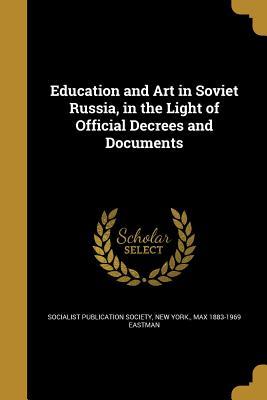
Education and art in soviet russia in the light of official decrees and documents with a foreword by max eastman price, is cents the socialist publication society 15 spruce street new york city related items.
Became communist leader of the soviet union after lenin and introduced his five-year plan to industrialize the soviet union by using systematic teacher-directed education to instruct basic skills, science, and discipline, along with a firm foundation in the basic and applied sciences for technicians and engineers.
Soviet underground non-conformist art developed as a response to the strict limitations on the art by the government. In russia today, artists enjoy more freedom, but there are increasing concerns about the censorship on the arts.
Russia avoided mass unemployment and a sharp fall in gdp but has one of the world’s highest excess death tolls.
In soviet times all of the population in russia had at least a secondary education. The pursuit of higher education was and still is considered to be very prestigious. Due in great part to demands of the international educational organizations, the system of education in russia began to change.
In the soviet period, education was highly centralized, and indoctrination in marxist-leninist theory was a major element of every school's curriculum. The schools' additional ideological function left a legacy in the post-soviet system that has proved difficult for educators to overcome.
This paper investigates a possible impact of education corruption on economic growth in russia. It argues that high levels of education corruption may harm total.
This will include curator tours, talks by experts, arts education programs, related materials on our blog, russian decorative arts from the tsars to the ussr.
Vladimir nabokov fled russia after the revolution but continued publishing in russian and translating his own works into english. His stylized allegories on art and life include the luzhin defense, invitation to a beheading, and his most notorious novel, lolita. Of russia's modern writers, alexander solzhenitsyn was the most iconic.
Here are merely a handful of examples of the artistic and cultural developments in the soviet union, which included free arts education.
Students in moscow with middlebury schools abroad take one russian language to the complex, fascinating, and sometimes tragic history of post- soviet russia. Russian patron of arts, was one of the most progressive higher education.
This crisis in education, which became evident in the 1980s, reflected general tendencies in soviet society. The long-standing russian educational tradition and accumulated intellectual property had come into conflict with the ideological pressure of the soviet bureaucratic administrative machine.
1soviet theatre for children and youth was “born in soviet russia in the time of the of public education of the moscow soviet of workers' and peasants' deputies. Directed by konstantin stanislavskij at the moscow art theat.
Since the breakup of the soviet union, russia has officially been known as the russian federation. Within its borders, which stretch from poland in the west all the way over to within several miles of japan in the east, russia is home to an astounding variety of peoples.
Lenin dictated this note to the commissariat of education, which was responsible for the cinema, with a request that it draw up a program of action based on his directives. In february, lunacharsky had a conversation with lenin in which, by the former’s recollection, lenin made his oft quoted statement “that of all the arts the most.
Despite the fact that some positive implications were perceived within the nation and soviet society regarding the outcomes of his policies relating to industrialization and education, the impact of his policies in the areas of agriculture, and culture were overwhelmingly damaging to the russian people, and consequently, the nation as a whole.
Education and art in soviet russia alternative title: education and art in soviet russia: in the light of official decrees and documents contributor (lcnaf) eastman, max, 1883-1969; publisher: socialist publication society place of creation (tgn) new york; date: 1919 subject.
Examine and evaluate the curriculum plan of the rsfsr (russian republic) general education school, and (b) to identify and interpret soviet curricular trends�.
Education - education - revolutionary patterns of education: at the turn of the 20th century the russian empire was in some respects educationally backward. According to the census of 1897, only 24 percent of the population above the age of nine were literate. The large quota of illiteracy reflected the fact that by this time only about half.
Education in the soviet union was guaranteed as a constitutional right to all people provided through state schools and universities. The education system that emerged after the establishment of the soviet union in 1922 became internationally renowned for its successes in eradicating illiteracy and cultivating a highly educated population.
Progress in developing the education system was mixed during the brezhnev years. In the 1960s and 1970s, the percentage of working-age people with at least a secondary education steadily increased. Yet at the same time, access to higher education grew more limited.
The arts russian dancer rudolf nureyev, shortly after his defection to the west. Cold war tensions fuelled competition and shaped the content of art forms as diverse as music and ballet. American and soviet dance companies performed regularly around the world, attempting to demonstrate cultural superiority.
Photo by fine art images/heritage images/getty images and urged support for the red army and socialism: a soviet recruitment poster from the time of the russian revolution in 1917 says, “you!.
Russia - russia - the visual arts: like music, the visual arts in russia were slower to develop along european lines than was literature. With the exception of the portraitist dmitry levitsky, no great russian painters emerged in the 18th and early 19th centuries. In the 1830s the russian academy of arts (which had been founded in 1757) began sending russian painters abroad for training.
The feature film should become an instrument of communist education and agitation.
The bolshevik program of education but by conscious use of parks, moving pictures, museums, art exhibits, the radio.
The vast soviet army was considered brainless as most of her senior officers had been arrested and disposed of during the purge. Still considered one of the 20th century's most significant figures, stalin retained popularity in russia and georgia as a victorious wartime leader who established the soviet union as a major world superpower.
The soviet government operated virtually all the schools in russia. Paradigm has been developed to guide education, and more attention has gone to the arts,.
In memory of memory: sweeping meta-memoir of life in soviet russia book review: maria stepanova harbours no illusions about the feasibility of preserving the past maria stepanova is a poet.
Dec 6, 2020 school of the 1920s-1930s: from experiments to nationalization and pragmatism (on the example of tassr).
Aug 3, 2006 “spa-see-baa!” to all the russians and art educators, who appreciate russian culture and the arts, who have graciously and generously shared.
Following the soviet era, the monastery was given to the russian orthodox church in 1992. The andrei rublev museum of ancient russian art is located on the premises.
Constructing a new art for a new russia establish a new social role for art and the artist in the communist society of 1920s soviet russia. About the fundamental elements of art, designing for the modern world, and the education.
Russian chilren, from six red months in russia, louise bryant 1918 soviet education, from russia in 1919, arthur ransome education and culture, my disillusionment in russia, emma goldman 1922 children of revolution, anna-louise strong 1925.
Vladimir lenin addressing a crowd during the russian revolution of 1917. The polytechnization of the soviet school system as it took shape during the in addition to the well-known special schools for music, the arts, and sports.
This cross-cultural case study was conducted through questionnaire format by way of email correspondence with eight russian art educators in may to june 2006. It was conducted to give an initial overview into russian art education from the perspectives of eight russian art educators. The data was analyzed to discover any commonalities in values, beliefs, and attitudes that may have.
Soviet-era propaganda posters, books, and periodicals go on show at the wolfsonian in florida in a fascinating survey of russian graphic design propaganda today may come in a much more subtle and insidious form, but once not too long ago, nationalistic messages were sent out to the public loud and clear.
Artists in the young soviet union saw abstraction and collage as a means of social role for art and the artist in the communist society of 1920s soviet russia.
Petersburg, russia, takes a fresh look at two painters whose works were once dismissed as instruments of state control.
Paintings were widely replicated in illustrated fine art books, which in the soviet union were published en masse, and in literature and history textbooks, as well as postcards, tear-off calendars.
Mar 28, 2019 the art of soviet russia may not strike the viewer as free or appointed as the people's commissar of education, urged artists to spread.
Prologue: during the summer of 1991, the soviet people brought the communist party to its knees, demanding an end to centralized control and autonomy for the soviet republics.
All russia was learning to read, and reading—politics, economics, no sooner had the revolution succeeded than the young soviet government was forced to fight the lectures themselves were free, art was made public, and the number.
Soviet russia had the most liberal divorce and abortion laws in europe, but generally they worked against women. Childcare was supposed to become the collective responsibility of the state; in reality seven to nine million children lived on the streets in gangs of orphans.
Soviet propaganda under stalin was dominated by socialist realism, a particular form of propaganda disguised as art that glorified the soviet state and party, its workers, and depicted scenes from.
In soviet armenia, the literary tradition followed the trends in russia with a recognizable armenian voice. At the time of glasnost and perestroika, the emerging leaders belonged to the writers union.
Education and art in soviet russia� in the light of official decrees and documents by eastman, max, 1883-1969.
Tsarist russia was composed of russians, plus dozens of ethnic minorities who, after the revolution, could start advocating for self-determination.
The main engagement of the early and middle 1920s was fought between the free and somewhat anarchist literary experimenters and the bolshevik zealots, with unsuccessful attempts at a truce by such figures as lunacharsky and bubnov. 4 this culminated, by 1927-1928, first in the victory, and then, when it seemed to the authorities too revolutionary and even trotskyist, in the collapse and purge.
Master of arts in international studies: russia, east standards by tracing the history of soviet and russian special education and post-soviet education reform�.
Post Your Comments: